

Your daily news update on Asia and the Pacific
Provided by AGP
Philippines Air Compressor Market 2026-2034 | Size, Share, Report
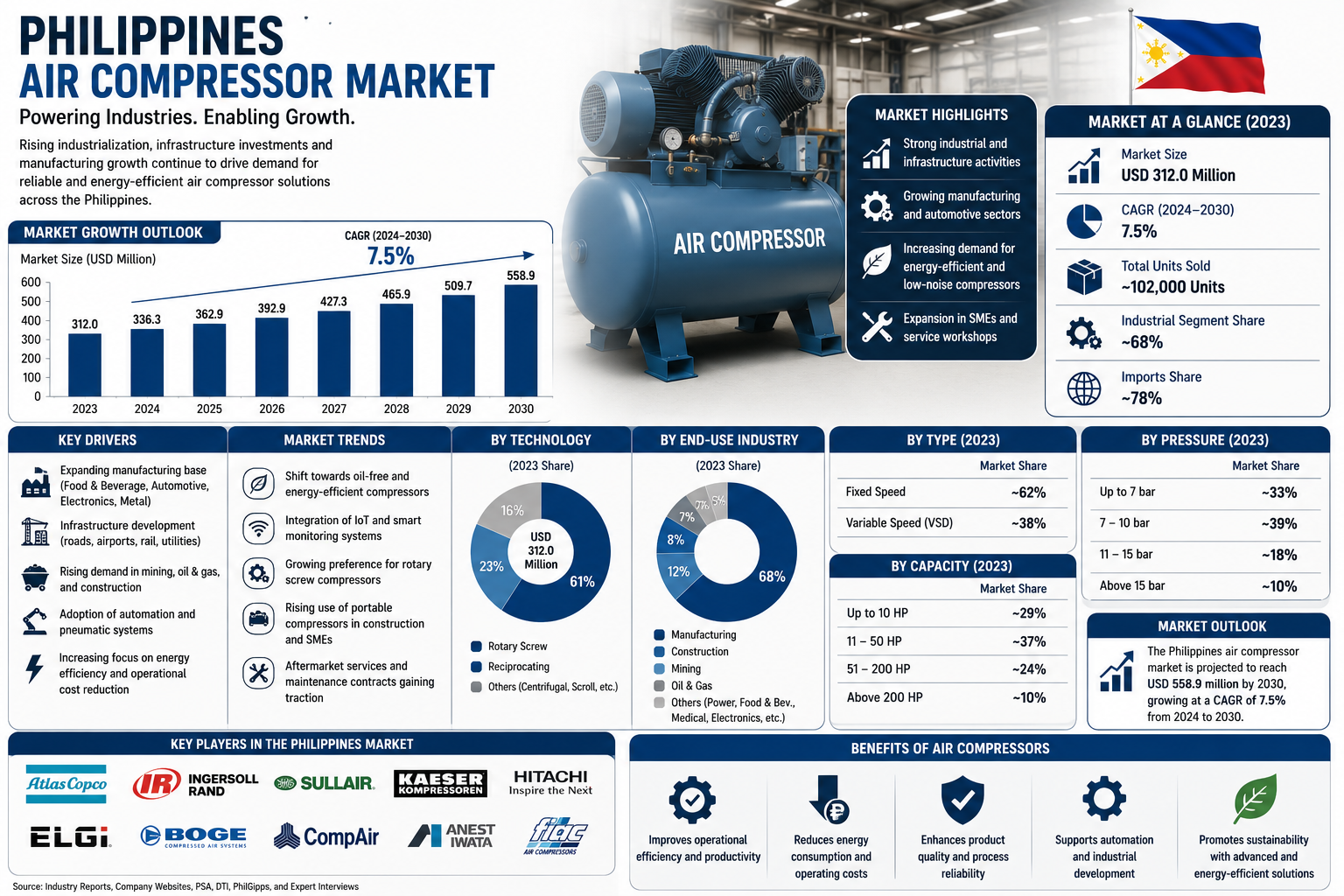
Philippines Air Compressor Market
Philippines air compressor market size was valued at USD 393.37 Million in 2025 and is projected to reach USD 512.18 Million by 2034, CAGR of 2.98% 2026-2034.
PHILIPPINES, May 19, 2026 /EINPresswire.com/ --𝗠𝗮𝗿𝗸𝗲𝘁 𝗢𝘃𝗲𝗿𝘃𝗶𝗲𝘄:
The Philippines air compressor market reached 𝗨𝗦𝗗 𝟯𝟵𝟯.𝟯𝟳 𝗠𝗶𝗹𝗹𝗶𝗼𝗻 in 2025 and is projected to reach 𝗨𝗦𝗗 𝟱𝟭𝟮.𝟭𝟴 𝗠𝗶𝗹𝗹𝗶𝗼𝗻 by 2034, exhibiting a growth rate (𝗖𝗔𝗚𝗥) 𝗼𝗳 𝟮.𝟵𝟴% 𝗱𝘂𝗿𝗶𝗻𝗴 𝟮𝟬𝟮𝟲–𝟮𝟬𝟯𝟰. The Philippines is rapidly establishing itself as a strategic manufacturing and industrial hub in Southeast Asia, with its manufacturing sector projected to reach USD 89.9 billion and industrial output growing at 4.9% year-on-year. Compressed air remains a critical utility across the country's expanding food and beverage processing plants, semiconductor fabrication facilities, pharmaceutical production units, mining operations, and large-scale infrastructure construction projects — with the government's Build Better More program allocating approximately USD 26 billion to infrastructure development and the landmark Malampaya East-1 natural gas discovery opening new frontiers for energy sector compressor demand.
𝗪𝗵𝘆 𝗶𝘀 𝗛𝗼𝘁 𝗧𝗼𝗱𝗮𝘆 𝗣𝗵𝗶𝗹𝗶𝗽𝗽𝗶𝗻𝗲𝘀 𝗔𝗶𝗿 𝗖𝗼𝗺𝗽𝗿𝗲𝘀𝘀𝗼𝗿 𝗠𝗮𝗿𝗸𝗲𝘁?
The Philippines discovered its first major natural gas field — Malampaya East-1, estimated at 98 billion cubic feet — in January 2026, driving fresh demand for compression equipment across the energy sector; Prime Energy committed an initial USD 600 million investment to bring Malampaya Phase 4 into commercial gas production by late 2026; Samsung reportedly plans to invest approximately US$1 billion in a new manufacturing facility in the Philippines; the Philippine Development Plan 2023–2028 is accelerating regional industrial corridor development across Visayas and Mindanao; industrial machinery demand is growing at 6.5% annually through 2032; and the Asian Development Bank has identified manufacturing automation and energy-efficient industrial systems as priority investment areas for the Philippines.
𝗣𝗵𝗶𝗹𝗶𝗽𝗽𝗶𝗻𝗲𝘀 𝗔𝗶𝗿 𝗖𝗼𝗺𝗽𝗿𝗲𝘀𝘀𝗼𝗿 𝗠𝗮𝗿𝗸𝗲𝘁 Summary:
• The Philippines manufacturing sector is projected to reach USD 89.9 billion, with production increasing 4.9% year-on-year — the fastest rate in ten months — led by demand in food processing, transportation equipment, and renewed export momentum. Compressed air systems are powering critical processes across these expanding manufacturing operations, from pneumatic assembly tools and conveyor systems to spray painting, packaging, and clean room ventilation — making air compressors an indispensable utility across the country's industrial base.
• The landmark discovery of the Malampaya East-1 natural gas field — estimated at 98 billion cubic feet off Palawan — in January 2026, followed by the even larger Camago-3 discovery flowing at up to 60 million standard cubic feet per day, is creating substantial new demand for compression equipment across the Philippines' energy sector. Prime Energy has committed an initial USD 600 million investment to bring Malampaya Phase 4 into commercial production by late 2026, with gas-to-power operations requiring high-pressure compressors for extraction, processing, and pipeline transport.
• The government's Build Better More infrastructure program is allocating approximately USD 26 billion to infrastructure development, encompassing 194 flagship projects across transportation, power generation, health facilities, and water resources. This massive construction activity is driving demand for portable diesel-powered air compressors used in pneumatic drilling, concrete breaking, sandblasting, tunnel boring, and pile driving operations across road, rail, airport, and seaport construction sites throughout the archipelago.
• The Philippines is emerging as a key electronics and semiconductor manufacturing destination in Southeast Asia, with Samsung reportedly planning a US$1 billion facility investment and the country's electronics exports continuing to anchor its manufacturing output. Semiconductor fabrication and electronics assembly require oil-free, Class 0 compressed air systems to maintain cleanroom environments — with the global oil-free compressor segment accounting for USD 3.46 billion in Asia Pacific alone, and the Philippines positioning itself to capture growing share of this demand as new fabrication facilities come online.
• The food and beverage processing industry in the Philippines — one of the fastest-growing manufacturing segments — is driving significant demand for oil-free and food-grade compressed air systems. Compressed air is essential for food packaging, bottling, filling, conveying, and freeze-drying operations, with the food and beverage sector accounting for approximately 34% of global oil-free compressor installations. As Philippine food processors scale up operations to serve both domestic consumption and export markets, demand for hygienic compressed air solutions is accelerating across dairy, beverage, bakery, and seafood processing facilities.
• The Philippine Development Plan 2023–2028 is catalyzing regional industrial corridor development beyond the traditional Metro Manila-Calabarzon manufacturing hub, promoting investment in Visayas and Mindanao through infrastructure upgrades, digitalization, logistics streamlining, and industrial zone expansion. This geographic diversification of manufacturing activity is creating new pockets of compressed air demand across previously underserved industrial regions, with new investments projected to create over 5,000 manufacturing jobs and drive procurement of industrial equipment including air compressor systems.
• The pharmaceutical and healthcare manufacturing sector in the Philippines is expanding, with compressed air serving as a critical utility for tablet pressing, capsule filling, clean room pressurization, and medical device assembly. Pharmaceutical applications contribute approximately 22% of global oil-free compressor demand, and as the Philippines strengthens its domestic pharmaceutical production capacity — supported by government healthcare infrastructure investment — demand for ISO 8573-1 Class 0 certified compressed air systems is rising to meet stringent GMP compliance requirements.
𝗛𝗼𝘄 𝗔𝗜 𝗶𝘀 𝗥𝗲𝘀𝗵𝗮𝗽𝗶𝗻𝗴 𝘁𝗵𝗲 𝗣𝗵𝗶𝗹𝗶𝗽𝗽𝗶𝗻𝗲𝘀 𝗔𝗶𝗿 𝗖𝗼𝗺𝗽𝗿𝗲𝘀𝘀𝗼𝗿 𝗠𝗮𝗿𝗸𝗲𝘁:
Artificial intelligence is rapidly transforming the Philippines air compressor market, fundamentally changing how compressed air systems are monitored, maintained, optimized, and integrated into smart manufacturing environments — delivering a new generation of predictive maintenance capabilities, energy optimization intelligence, and autonomous system management that is helping Philippine industrial facilities reduce unplanned downtime by 30–50%, lower maintenance costs by 18–25%, and extend compressor equipment lifespan by 20–40% across the country's expanding manufacturing, energy, and construction sectors.
𝗥𝗲𝗾𝘂𝗲𝘀𝘁 𝗳𝗼𝗿 𝗮 𝘀𝗮𝗺𝗽𝗹𝗲 𝗿𝗲𝗽𝗼𝗿𝘁 𝗣𝗗𝗙: https://www.imarcgroup.com/philippines-air-compressor-market/requestsample
𝗠𝗮𝗿𝗸𝗲𝘁 𝗧𝗿𝗲𝗻𝗱𝘀 𝗮𝗻𝗱 𝗜𝗻𝘀𝗶𝗴𝗵𝘁𝘀:
• The Philippines' rapid infrastructure expansion — driven by the Build Better More program's USD 26 billion allocation across 194 flagship projects — is generating sustained demand for portable and stationary air compressors used in construction, tunneling, bridge building, and road development operations. Large-scale projects including new rail networks, airport expansions, and seaport upgrades require pneumatic drilling, sandblasting, and concrete spraying equipment powered by industrial-grade compressed air systems, positioning the construction sector as a primary growth engine for compressor demand across the archipelago.
• The growing emphasis on energy efficiency and total cost of ownership is driving Philippine industrial facilities to replace aging reciprocating compressors with modern rotary screw and Variable Speed Drive (VSD) models that deliver 15–35% energy savings. With the Asian Development Bank identifying energy-efficient industrial systems as a priority investment area for the Philippines, and electricity costs continuing to rise across industrial tariff categories, manufacturers are increasingly investing in premium compressor technologies that reduce operational expenditure while meeting tightening environmental compliance requirements.
• The offshore energy sector is emerging as a significant new demand driver following the January 2026 Malampaya East-1 discovery and the subsequent Camago-3 find flowing at up to 60 million standard cubic feet per day. Prime Energy's USD 600 million investment commitment for Malampaya Phase 4 commercial production by late 2026 — combined with plans for a potential LNG terminal and expanded gas processing infrastructure — is creating fresh requirements for high-pressure gas compression, pipeline boosting, and process air systems across the Philippines' developing natural gas value chain.
• The semiconductor and electronics manufacturing segment is experiencing growing momentum, with Samsung's reported US$1 billion investment commitment and the Philippines' established position as a major electronics exporter driving demand for oil-free, Class 0 compressed air systems. The oil-free compressor segment in Asia Pacific alone is valued at USD 3.46 billion, with semiconductor fabrication requiring ultra-clean compressed air for wafer handling, lithography, and cleanroom pressurization — and the Philippines positioning to capture increased share as new fabrication and assembly facilities expand operations.
• The adoption of smart compressor technologies — including IoT-connected monitoring platforms, AI-powered predictive maintenance systems, and cloud-based fleet management tools — is accelerating across Philippine manufacturing facilities seeking to reduce unplanned downtime by 30–50% and lower maintenance costs by 18–25%. Atlas Copco's SMARTLINK platform and similar connected compressor solutions are enabling Philippine service networks to transition from reactive to predictive maintenance models, while providing facility managers with real-time visibility into energy consumption, air quality, and equipment health across distributed compressor fleets.
𝗠𝗮𝗿𝗸𝗲𝘁 𝗚𝗿𝗼𝘄𝘁𝗵 𝗗𝗿𝗶𝘃𝗲𝗿𝘀:
𝗜𝗻𝗳𝗿𝗮𝘀𝘁𝗿𝘂𝗰𝘁𝘂𝗿𝗲 𝗘𝘅𝗽𝗮𝗻𝘀𝗶𝗼𝗻 𝗮𝗻𝗱 𝗖𝗼𝗻𝘀𝘁𝗿𝘂𝗰𝘁𝗶𝗼𝗻 𝗕𝗼𝗼𝗺
The Philippines' Build Better More infrastructure program — allocating approximately USD 26 billion across 194 flagship projects encompassing transportation networks, power generation facilities, health infrastructure, and water resource systems — is one of the most powerful demand drivers for air compressors in the country. Large-scale construction operations require portable diesel compressors for pneumatic drilling, rock breaking, sandblasting, and tunnel ventilation, while permanent infrastructure installations demand stationary compressed air systems for ongoing facility operations. The geographic spread of infrastructure investment across Luzon, Visayas, and Mindanao is dispersing compressor demand beyond the traditional Metro Manila-Calabarzon industrial corridor, creating new market opportunities for compressor distributors and service networks in previously underserved regions. New investments are projected to create over 5,000 manufacturing jobs, each representing incremental compressed air system procurement requirements.
𝗘𝗻𝗲𝗿𝗴𝘆 𝗦𝗲𝗰𝘁𝗼𝗿 𝗗𝗲𝘃𝗲𝗹𝗼𝗽𝗺𝗲𝗻𝘁 𝗮𝗻𝗱 𝗡𝗮𝘁𝘂𝗿𝗮𝗹 𝗚𝗮𝘀 𝗘𝘅𝗽𝗮𝗻𝘀𝗶𝗼𝗻
The January 2026 discovery of the Malampaya East-1 natural gas field — estimated at 98 billion cubic feet — followed by the even larger Camago-3 discovery flowing at up to 60 million standard cubic feet per day, is opening a transformative new chapter for compressor demand in the Philippines' energy sector. Prime Energy has committed an initial USD 600 million investment for Malampaya Phase 4 commercial production, with gas extraction, processing, and pipeline transport operations requiring high-pressure centrifugal and reciprocating compressors capable of handling demanding offshore and onshore applications. The Malampaya gas field already powers approximately 20% of Luzon's electricity through gas-to-power generation, and the expansion of domestic gas production — offering fuel costs of approximately PHP 4.80 per kilowatt hour versus PHP 10.30 for imported LNG — is structurally strengthening the economic case for compression infrastructure investment across the Philippines' energy value chain.
𝗠𝗮𝗻𝘂𝗳𝗮𝗰𝘁𝘂𝗿𝗶𝗻𝗴 𝗗𝗶𝘃𝗲𝗿𝘀𝗶𝗳𝗶𝗰𝗮𝘁𝗶𝗼𝗻 𝗮𝗻𝗱 𝗙𝗼𝗿𝗲𝗶𝗴𝗻 𝗜𝗻𝘃𝗲𝘀𝘁𝗺𝗲𝗻𝘁 𝗜𝗻𝗳𝗹𝗼𝘄𝘀
The Philippines is experiencing a structural transformation of its manufacturing base, with the sector projected to reach USD 89.9 billion and production growing at 4.9% year-on-year across food processing, transportation equipment, electronics, and pharmaceuticals. Samsung's reported US$1 billion investment in a new Philippine manufacturing facility, combined with growing foreign direct investment attracted by the country's young workforce, competitive labor costs, and government incentive programs, is creating expanding demand for industrial compressed air systems across diverse manufacturing applications. The Philippine Development Plan 2023–2028 is actively promoting regional industrial corridor development, digitalization, and logistics modernization — with the Asian Development Bank identifying manufacturing automation and energy-efficient industrial systems as priority investment areas — collectively strengthening the structural foundations for sustained air compressor market growth across the Philippines' diversifying industrial economy.
𝗠𝗮𝗿𝗸𝗲𝘁 𝗦𝗲𝗴𝗺𝗲𝗻𝘁𝗮𝘁𝗶𝗼𝗻:
IMARC Group's research categorizes the Philippines air compressor market as follows:
𝗕𝘆 𝗧𝘆𝗽𝗲:
• Portable
• Stationary
𝗕𝘆 𝗧𝗲𝗰𝗵𝗻𝗼𝗹𝗼𝗴𝘆:
• Reciprocating/Piston
• Rotary/Screw
• Centrifugal
𝗕𝘆 𝗟𝘂𝗯𝗿𝗶𝗰𝗮𝘁𝗶𝗼𝗻:
• Oil-Filled
• Oil-Free
𝗕𝘆 𝗣𝗼𝘄𝗲𝗿 𝗥𝗮𝘁𝗶𝗻𝗴:
• 0-100 kW
• 101-300 kW
• 301-500 kW
• 501 kW and Above
𝗕𝘆 𝗘𝗻𝗱 𝗨𝘀𝗲:
• Manufacturing
• Semiconductors and Electronics
• Food and Beverages
• Healthcare/Medical
• Home Appliances
• Energy
• Oil and Gas
• Others
𝗕𝘆 𝗥𝗲𝗴𝗶𝗼𝗻:
• National Capital Region (NCR)
• Central Luzon
• Calabarzon
• Visayas
• Mindanao
𝗞𝗲𝘆 𝗣𝗹𝗮𝘆𝗲𝗿𝘀:
The competitive landscape of the Philippines air compressor market includes a comprehensive analysis of key player positioning, market structure, top winning strategies, competitive dashboards, and company evaluation quadrants. Some of the key players operating in the market include Atlas Copco AB, Ingersoll Rand Inc., Kaeser Kompressoren SE, ELGi Equipments Limited, Hitachi Ltd., Doosan Corporation, Siemens Energy AG, Sullair (a Hitachi Group Company), Bauer Compressors Inc., and Compresstech Resources Inc. Detailed profiles of all major companies are provided within the full IMARC Group research report.
𝗥𝗲𝗰𝗲𝗻𝘁 𝗡𝗲𝘄𝘀 𝗮𝗻𝗱 𝗗𝗲𝘃𝗲𝗹𝗼𝗽𝗺𝗲𝗻𝘁𝘀:
𝗠𝗮𝘆 𝟮𝟬𝟮𝟲: Ingersoll Rand and Garrett Motion announced a collaboration to accelerate the development of next-generation oil-free industrial air compressor technology, combining Ingersoll Rand's compressed air expertise with Garrett's high-speed electric motor and air bearing technology to deliver ultra-efficient, oil-free compressed air solutions for contamination-sensitive manufacturing environments.
𝗔𝗽𝗿𝗶𝗹 𝟮𝟬𝟮𝟲: Prime Energy confirmed that the Camago-3 well off Palawan — a second major natural gas discovery following Malampaya East-1 — flowed at rates of up to 60 million standard cubic feet per day, with results indicating a resource approximately 2.5 times larger than the January 2026 discovery, significantly expanding the Philippines' domestic gas compression infrastructure requirements.
𝗝𝗮𝗻𝘂𝗮𝗿𝘆 𝟮𝟬𝟮𝟲: The Philippines announced the discovery of the Malampaya East-1 natural gas field — estimated at 98 billion cubic feet off Palawan — drilled by Prime Energy (45%), UC38 LLC (45%), and PNOC (10%), with the consortium committing an initial USD 600 million investment for Malampaya Phase 4 commercial production by late 2026.
𝗗𝗲𝗰𝗲𝗺𝗯𝗲𝗿 𝟮𝟬𝟮𝟱: Atlas Copco unveiled its latest compact portable air compressor models — the XAS 58 and XAS 78 — designed for construction and industrial applications, featuring improved fuel efficiency and reduced noise levels suited to urban construction environments across Southeast Asian markets including the Philippines.
𝗝𝘂𝗹𝘆 𝟮𝟬𝟮𝟱: Ingersoll Rand acquired Termomeccanica Industrial Compressors S.p.A. (TMIC) and subsidiary Adicomp S.p.A. for approximately EUR 160 million, expanding its engineered-to-order compressor portfolio with gas and process compression solutions for the renewable natural gas (RNG) industry — strengthening its Asia Pacific product offerings.
𝗝𝘂𝗹𝘆 𝟮𝟬𝟮𝟱: Ingersoll Rand introduced the META Contact Cool Compressor in Europe, featuring an 11% increase in air flow while occupying 40% less floor space and delivering 14% reduction in energy consumption — with plans for global rollout across key Asian markets in 2026.
𝗤𝟯 𝟮𝟬𝟮𝟱: Atlas Copco reported continued service-network expansion across Asia Pacific, having completed 15 service-network acquisitions during 2024–2025 and embedding SMARTLINK analytics into legacy compressor fleets — extending connected monitoring capabilities to Philippine industrial customers through regional distribution partnerships.
𝗕𝗿𝗼𝘄𝘀𝗲 𝘁𝗵𝗲 𝗳𝘂𝗹𝗹 𝗿𝗲𝗽𝗼𝗿𝘁 𝘄𝗶𝘁𝗵 𝗧𝗢𝗖 𝗮𝗻𝗱 𝗹𝗶𝘀𝘁 𝗼𝗳 𝗳𝗶𝗴𝘂𝗿𝗲𝘀: https://www.imarcgroup.com/philippines-air-compressor-market
𝗡𝗼𝘁𝗲: 𝗜𝗳 𝘆𝗼𝘂 𝗿𝗲𝗾𝘂𝗶𝗿𝗲 𝗮𝗻𝘆 𝘀𝗽𝗲𝗰𝗶𝗳𝗶𝗰 𝗶𝗻𝗳𝗼𝗿𝗺𝗮𝘁𝗶𝗼𝗻 𝘁𝗵𝗮𝘁 𝗶𝘀 𝗻𝗼𝘁 𝗰𝗼𝘃𝗲𝗿𝗲𝗱 𝗰𝘂𝗿𝗿𝗲𝗻𝘁𝗹𝘆 𝘄𝗶𝘁𝗵𝗶𝗻 𝘁𝗵𝗲 𝘀𝗰𝗼𝗽𝗲 𝗼𝗳 𝘁𝗵𝗲 𝗿𝗲𝗽𝗼𝗿𝘁, 𝘄𝗲 𝘄𝗶𝗹𝗹 𝗽𝗿𝗼𝘃𝗶𝗱𝗲 𝘁𝗵𝗲 𝘀𝗮𝗺𝗲 𝗮𝘀 𝗮 𝗽𝗮𝗿𝘁 𝗼𝗳 𝘁𝗵𝗲 𝗰𝘂𝘀𝘁𝗼𝗺𝗶𝘇𝗮𝘁𝗶𝗼𝗻.
Other Report by IMARC Group:
Philippines Programmable Logic Controller (PLC) Market 2026: https://www.imarcgroup.com/philippines-programmable-logic-controller-market
Philippines Battery Materials Market 2026: https://www.imarcgroup.com/philippines-battery-materials-market
Philippines Automotive Wiring Harness Market 2026: https://www.imarcgroup.com/philippines-automotive-wiring-harness-market
Philippines Industrial Gases Market 2026: https://www.imarcgroup.com/philippines-industrial-gases-market
Philippines Tin Market 2026: https://www.imarcgroup.com/philippines-tin-market
𝗔𝗯𝗼𝘂𝘁 𝗨𝘀
IMARC Group is a global management consulting firm that helps the world's most ambitious changemakers to create a lasting impact. The company provides a comprehensive suite of market entry and expansion services. IMARC offerings include thorough market assessment, feasibility studies, company incorporation assistance, factory setup support, regulatory approvals and licensing navigation, branding, marketing and sales strategies, competitive landscape and benchmarking analyses, pricing and cost research, and procurement research.
𝗖𝗼𝗻𝘁𝗮𝗰𝘁 𝗨𝘀
𝗜𝗠𝗔𝗥𝗖 𝗚𝗿𝗼𝘂𝗽
134 N 4th St., Brooklyn, NY 11249, USA
𝗘𝗺𝗮𝗶𝗹: sales@imarcgroup.com
𝗧𝗲𝗹. 𝗡𝗼.: (D) +91 120 433 0800
𝗨𝗻𝗶𝘁𝗲𝗱 𝗦𝘁𝗮𝘁𝗲𝘀: +1-201-971-6302
Elena Anderson
IMARC Services Private Limited
+1 201-971-6302
email us here
Legal Disclaimer:
EIN Presswire provides this news content "as is" without warranty of any kind. We do not accept any responsibility or liability for the accuracy, content, images, videos, licenses, completeness, legality, or reliability of the information contained in this article. If you have any complaints or copyright issues related to this article, kindly contact the author above.
