

Your daily news update on Asia and the Pacific
Provided by AGP
Australia Cargo Security and Surveillance Market 2026-2034 | Size, Share, Report
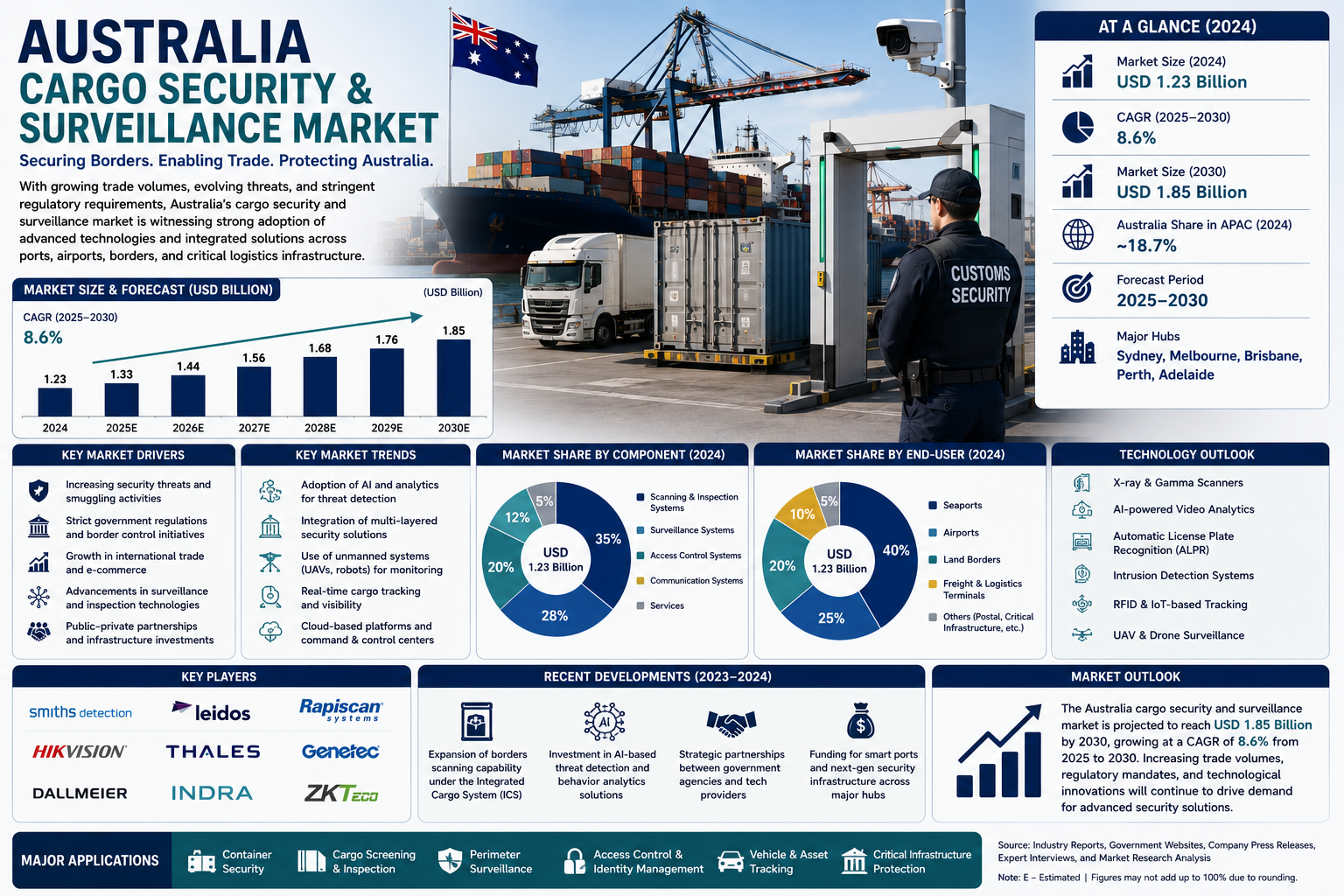
Australia Cargo Security and Surveillance Market
Australia cargo security and surveillance market valued at USD 87.30 Million in 2025, is projected to reach USD 212.13 Million 2034, CAGR of 10.37% 2026-2034.
AUSTRALIA, May 19, 2026 /EINPresswire.com/ --Market Overview
The Australia cargo security and surveillance market size was valued at USD 87.30 Million in 2025 and is projected to reach USD 212.13 Million by 2034, growing at a compound annual growth rate of 10.37% from 2026-2034. The market is witnessing substantial momentum as cargo protection is becoming a strategic priority across Australia's increasingly complex and high-value supply chains. With the country strengthening its global position as a major exporter of commodities, minerals, agricultural products, and manufactured goods, the demand for intelligent monitoring and risk mitigation solutions is accelerating across ports, warehouses, freight corridors, and distribution hubs. Cargo security surveillance is rapidly evolving from basic monitoring into intelligent, data-driven systems that are designed to prevent theft, minimise losses, and enhance supply chain resilience. The growing integration of technologies such as AI-powered video analytics, IoT sensor networks, RFID tracking, and cloud-based management platforms is reshaping how Australian logistics operators protect and monitor high-value cargo movements across the country.
Why is Hot Today
The Australia cargo security and surveillance market is gaining significant attention as the Australian Government is undertaking a major overhaul of its Security of Critical Infrastructure (SOCI) Act, with proposed amendments published in March 2026 following an independent review by Dr Jill Slay AM. These reforms are imposing enhanced obligations on supply chain security, cyber-physical protection, and personnel screening for critical infrastructure operators across 11 sectors and 22 asset types. Simultaneously, the Australian Border Force is expanding its big data analysis ecosystem and machine learning capabilities to monitor cargo entering and leaving the country, drawing together multiple data sources to provide enhanced analytical insights. The NSW Government is also investing $50 million to deploy thousands of IoT sensors across port precincts, while the Port of Townsville is launching a large-scale renewable energy cargo hub to handle oversized freight and wind turbine components, reflecting the broader push toward smarter, more secure logistics infrastructure.
Market Summary
• The Australia cargo security and surveillance market is evolving rapidly as logistics operators are shifting from basic CCTV monitoring toward integrated, data-driven security platforms that combine video analytics, GPS tracking, RFID tagging, and AI-powered threat detection to deliver real-time visibility across transport and storage environments.
• Rising cargo theft incidents and supply chain vulnerabilities are driving demand for advanced surveillance solutions, with just-in-time delivery models and interconnected logistics networks making high-value shipments increasingly susceptible to tampering, diversion, and theft during transit and at storage facilities.
• The Integrated Cargo System (ICS), managed by the Australian Border Force and the Department of Agriculture, Fisheries and Forestry (DAFF), is serving as the central electronic platform for processing all import and export declarations, reinforcing the digital backbone that supports cargo security operations nationwide.
• Cloud-based surveillance management solutions are experiencing growing adoption among logistics companies, enabling remote monitoring of multiple facilities from centralised control centres and reducing the need for on-site security personnel while improving response times across nationally distributed networks.
• The expansion of e-commerce fulfilment centres and the growth of domestic freight volumes are creating substantial demand for warehouse and distribution hub surveillance, with operators investing in perimeter security, access control systems, and container-inspection protocols to protect assets throughout the handling process.
• Insurance providers are increasingly requiring logistics operators to demonstrate advanced security capabilities as a condition for cargo coverage, with companies that invest in AI-powered surveillance, real-time tracking, and automated access control systems benefiting from reduced premiums, lower exposure to liability claims, and improved long-term cost efficiency across their operations.
• Australia's growing role as a strategic partner in regional defence and security cooperation is reinforcing the demand for advanced cargo surveillance capabilities, with Lockheed Martin Australia's Global Supply Chain Program surpassing AUD $225 million in export contracts awarded to Australian industry partners and strengthening the domestic security technology manufacturing base.
How AI is Reshaping the Australia Cargo Security and Surveillance Market
Artificial intelligence is fundamentally transforming the Australia cargo security and surveillance market, shifting the industry from reactive monitoring to predictive, context-aware security operations. Australian freight leaders are now moving beyond pilot-stage AI projects into deep integration across day-to-day logistics and data infrastructure, making intelligent surveillance a core operational capability rather than an experimental add-on. The Australian Border Force is already leveraging machine learning capabilities across a range of analytical platforms to draw together multiple data sources and generate actionable insights on cargo movements, setting the benchmark for AI adoption across both public and private sector logistics operations.
• AI-Powered Video Analytics: Advanced computer vision algorithms are enabling surveillance cameras to automatically detect suspicious activities such as unauthorised access, package tampering, vehicle intrusion, and unusual movement patterns across freight terminals and warehouses, triggering instant alerts and reducing incident response times significantly compared to traditional manual monitoring approaches.
• Predictive Risk Management: Machine learning models are analysing historical cargo theft data, route patterns, and environmental conditions to predict high-risk shipments and transport corridors, enabling logistics operators to allocate security resources proactively before incidents occur.
• Automated Cargo Screening: AI-driven X-ray and CT scanning systems are enhancing container inspection accuracy at Australian ports and freight terminals, with automated threat detection algorithms identifying contraband, weapons, prohibited agricultural materials, and other dangerous goods faster and more reliably than manual screening methods, while also reducing bottlenecks in high-volume cargo processing environments.
• Intelligent Access Control: Facial recognition and biometric-based access control systems powered by AI are being deployed at critical logistics facilities, verifying authorised personnel in real time and maintaining comprehensive audit trails that support regulatory compliance under the SOCI Act framework.
• Adaptive Network Security: AI-enabled systems are integrating with IoT sensor networks across supply chains, correlating data from GPS trackers, RFID tags, and environmental sensors to provide a unified, adaptive security layer that automatically adjusts monitoring intensity based on real-time threat assessments.
Request for a sample report: https://www.imarcgroup.com/australia-cargo-security-surveillance-market/requestsample
Market Trends and Insights
• The convergence of physical surveillance and cybersecurity is emerging as a defining trend in the Australia cargo security and surveillance market, as the proposed SOCI Act amendments are mandating integrated cyber-physical protection measures for critical infrastructure operators managing ports, freight networks, and logistics hubs. With port automation, cargo scanners, and logistics networks increasingly connected to digital systems, the need for unified security approaches that address both physical cargo threats and cyber intrusion risks is becoming paramount.
• Smart port infrastructure is attracting substantial investment across Australia, with digital technologies including IoT platforms, real-time tracking systems, and automated container handling enhancing cargo visibility and operational efficiency at major terminals in Sydney, Melbourne, Brisbane, and Fremantle. Smart containers reinforced with IoT sensors, GPS, and RFID tags are providing real-time data about cargo movements, temperature, surrounding humidity, and records of container tampering.
• The deployment of drone-based surveillance systems is expanding across large-scale logistics facilities and freight corridors, providing aerial monitoring coverage that complements fixed camera networks and reduces the dependency on on-site security teams for perimeter patrol and incident investigation. These autonomous monitoring capabilities are being supported by remote monitoring hubs that enable centralised security management across geographically distributed logistics operations.
• Blockchain-enabled cargo tracking platforms are gaining traction among Australian freight operators, creating immutable, tamper-proof records of cargo movements and chain-of-custody documentation that strengthen accountability, reduce fraud risks, and support compliance with international trade security standards and regulatory requirements.
• The Cyber Security (Security Standards for Smart Devices) Rules 2025, effective from March 2026, are establishing baseline security requirements for connected IoT devices, including sensors and monitoring systems deployed across Australian logistics infrastructure, driving demand for compliant surveillance equipment.
• Real-time location systems (RTLS) combining GPS, RFID, and Bluetooth Low Energy technology are being integrated into cargo security platforms, enabling precise tracking of individual shipments and containers throughout their journey from origin to final delivery point. The Australian Government and IoT Alliance Australia are also planning to introduce a cyber security labelling scheme for IoT products from March 2027, ensuring that surveillance devices and tracking sensors meet standardised security requirements.
Market Growth Drivers
Regulatory Compliance and Critical Infrastructure Protection: The Australian Government's strengthening of the SOCI Act is one of the most significant growth drivers for the cargo security and surveillance market. The proposed amendments, released following the March 2026 independent review, are expanding security obligations across 11 critical infrastructure sectors covering 22 asset types. Logistics operators managing ports, freight terminals, and warehousing facilities are now facing enhanced requirements for cyber security, supply chain risk management, personnel screening, and physical security, with particular regard to risks arising from foreign ownership, control, or influence. These regulatory pressures are creating strong demand for integrated surveillance systems that can demonstrate compliance across multiple frameworks while providing comprehensive audit trails and incident reporting capabilities.
E-Commerce Expansion and Freight Volume Growth: Australia's booming e-commerce sector is generating unprecedented freight volumes that are directly fuelling investment in cargo surveillance infrastructure. The proliferation of fulfilment centres, last-mile distribution hubs, and intermodal freight terminals is creating new security requirements across an expanding logistics footprint. With higher package volumes moving through more touchpoints, logistics companies are deploying advanced surveillance solutions including AI-enabled cameras, automated access control, and real-time cargo tracking systems to maintain operational integrity and reduce shrinkage across their networks. The rise in cross-border e-commerce is also increasing the complexity of customs and border security operations, driving adoption of automated screening and digital manifest verification systems that can handle growing import volumes efficiently.
Smart Port Infrastructure Investment: Australia's major ports are undergoing significant digital transformation, with substantial government and private sector investment flowing into smart port initiatives. The NSW Government has committed $50 million toward installing IoT sensor networks across port precincts, while the Port of Townsville is launching a large-scale renewable energy cargo hub in April 2026 to handle wind turbine components and oversized freight. These infrastructure projects are embedding advanced surveillance capabilities directly into port operations, integrating CCTV networks, container tracking systems, smart containers equipped with IoT sensors and GPS, and automated inspection platforms to create comprehensive security ecosystems. The Australian Government's Civil Maritime Security Strategy is also reinforcing the need for enhanced cargo monitoring across the country's extensive Exclusive Economic Zone, with Leidos Australia providing fixed-wing border surveillance services under contract with the Australian Border Force to patrol maritime routes and protect trade corridors.
Market Segmentation
The report has segmented the market into the following categories:
Breakup by Security Type:
Cargo Screening and Inspection
Surveillance and Monitoring
Tracking and Tracing Systems
Access Control and Authentication
Breakup by Mode of Transport:
Air Cargo Security
Maritime Cargo Security
Rail Cargo Security
Road Cargo Security
Others
Breakup by Technology:
X-ray Scanners
Explosive Detection Systems (EDS)
Video Surveillance Systems
RFID & GPS-based Tracking
Breakup by End-User Industry
Logistics and Freight Forwarding
E-commerce and Retail
Aviation and Maritime Operators
Government and Defense
Breakup by Region:
Australia Capital Territory & New South Wales
Victoria
Queensland
Western Australia
Others
Note: The above segmentation is based on standard IMARC Group categorisation for security and surveillance markets. Please verify against the actual IMARC report page for exact segment breakdowns.
Key Players
Some of the key players in the Australia cargo security and surveillance market that are mentioned in the report include Smiths Detection Group Ltd., Honeywell International Inc., Bosch Security Systems GmbH, Axis Communications AB (Canon Inc.), Motorola Solutions Inc., Leidos Holdings Inc., Rapiscan Systems (OSI Systems Inc.), Hanwha Vision Co. Ltd., Teledyne FLIR LLC, and L3Harris Technologies Inc., among others. These companies are competing through innovation in AI-powered screening systems, integrated surveillance platforms, and smart logistics security solutions to capture growing demand across Australia's expanding cargo and freight infrastructure.
Recent News and Developments
• April 2026: The Australian Government's Department of Home Affairs is publishing proposed amendments to the Security of Critical Infrastructure (SOCI) Act following the independent review by Dr Jill Slay AM, introducing enhanced obligations for cyber security, supply chain risk management, personnel screening, and physical security across 11 critical infrastructure sectors including transport and logistics. The deadline for industry submissions on these reforms is set for May 2026.
• March 2026: The Cyber Security (Security Standards for Smart Devices) Rules 2025 are coming into effect, establishing mandatory baseline security standards for connected IoT devices deployed across Australian infrastructure, including surveillance sensors and monitoring systems used in cargo security operations.
• January 2026: Australian logistics operators are expanding deployment of AI-enabled surveillance systems across major warehouses and freight terminals, with these platforms improving real-time threat detection capabilities and significantly reducing incident response times across supply chain operations.
• November 2025: The Australian Defence Department is awarding a $180 million connectivity contract to strengthen secure communication networks across defence and security operations, reinforcing the broader technology ecosystem that supports cargo surveillance, maritime monitoring, and border protection capabilities throughout the country.
• September 2025: The Australian Border Force is updating its Secrecy and Disclosure Rule to modernise the framework governing information sharing between border agencies and logistics operators, enhancing collaboration on cargo security monitoring and compliance enforcement.
• May 2025: Logistics operators across Australia are accelerating investments in integrated cargo security platforms combining video surveillance, access control, RFID tagging, and real-time tracking data at ports and intermodal hubs, with authorities also boosting checks on container seals, cargo manifests, and real-time tracking data to prevent smuggling, theft, and cargo diversion.
Browse the full report with TOC & List of Figures: https://www.imarcgroup.com/australia-cargo-security-surveillance-market
Note: If you need any specific information that is not covered currently within the scope of the report, we will provide the same as a part of customization.
Other Report by IMARC Group:
Australia Command and Control System Market 2026: https://www.imarcgroup.com/australia-command-control-system-market
Australia Aviation Market 2026: https://www.imarcgroup.com/australia-aviation-market
Australia Firearms Market 2026: https://www.imarcgroup.com/australia-firearms-market
Australia Aerospace Fasteners Market 2026: https://www.imarcgroup.com/australia-aerospace-fasteners-market
Australia Furniture Fittings Market 2026: https://www.imarcgroup.com/australia-furniture-fittings-market
About Us
IMARC Group is a global management consulting firm that helps the world's most ambitious changemakers to create a lasting impact. The company provide a comprehensive suite of market entry and expansion services. IMARC offerings include thorough market assessment, feasibility studies, company incorporation assistance, factory setup support, regulatory approvals and licensing navigation, branding, marketing and sales strategies, competitive landscape and benchmarking analyses, pricing and cost research, and procurement research.
Contact Us
IMARC Group
134 N 4th St. Brooklyn, NY 11249, USA
Email: sales@imarcgroup.com
Tel No: (D) +91 120 433 0800
United States: +1-631-791-1145
Elena Anderson
IMARC Services Private Limited
+1 201-971-6302
email us here
Legal Disclaimer:
EIN Presswire provides this news content "as is" without warranty of any kind. We do not accept any responsibility or liability for the accuracy, content, images, videos, licenses, completeness, legality, or reliability of the information contained in this article. If you have any complaints or copyright issues related to this article, kindly contact the author above.
