

NVH Testing Market to Reach USD 4.68 Billion at a 5.42% CAGR by 2035 Driven by EV Development, and Rising Demand
nvh_testing_market_size
Powertrain NVH testing led the NVH Testing Market with a 31% revenue share in 2025, driven by EV NVH powertrain testing mandates for high-frequency
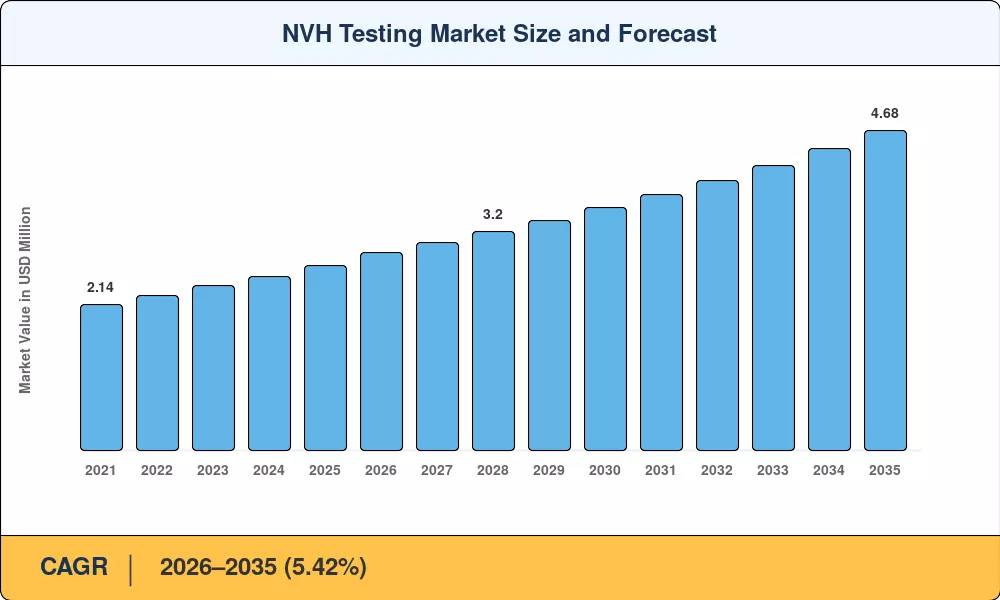
NY, CA, UNITED STATES, June 11, 2026 /EINPresswire.com/ -- NVH Testing Market Size was valued at USD 2.57 Billion in 2024 and is projected to grow from USD 2.71 Billion in 2025 to USD 4.68 Billion by 2035, registering a CAGR of 5.42% during the forecast period (2025–2035). Rising vehicle electrification, increasing focus on passenger comfort, stringent regulatory frameworks for vehicle noise, and growing investments in advanced testing infrastructure are expected to drive sustained market expansion globally.The global Noise, Vibration, and Harshness (NVH) Testing Market growth is witnessing consistent growth as automotive manufacturers, aerospace companies, industrial equipment producers, and transportation solution providers increasingly prioritize performance refinement, operational stability, and customer comfort. NVH testing has emerged as a critical engineering process for identifying and reducing unwanted sound, vibration, and harsh operational behavior in products ranging from automobiles and electric vehicles to aircraft systems and industrial machinery.
The increasing transition toward electric mobility has significantly transformed the dynamics of NVH testing requirements. Unlike internal combustion engine vehicles, electric vehicles operate with considerably lower engine noise, making secondary sounds such as road friction, motor whine, structural vibration, aerodynamic noise, and cabin acoustics more noticeable. As a result, automakers are investing heavily in advanced testing methodologies and simulation-based engineering to improve passenger experience and vehicle refinement.
Additionally, regulatory authorities across major automotive economies continue to strengthen standards surrounding vehicle acoustics, occupational noise exposure, and environmental sound management. Such regulations are encouraging manufacturers to adopt sophisticated testing systems capable of accurately identifying acoustic anomalies and structural vibration patterns at earlier stages of product development.
The growing emphasis on premium cabin experience, ride quality, and product reliability is expected to further strengthen demand for NVH testing solutions over the coming decade.
Ask for Sample PDF - https://www.marketresearchfuture.com/sample_request/9753
Competitive Landscape
The NVH testing market remains moderately competitive, with companies focusing heavily on technological innovation, strategic collaborations, software integration, and testing automation.
Major market participants are increasingly investing in AI-powered analytics, simulation technologies, and real-time diagnostic systems to improve testing accuracy and shorten product development cycles.
Industry participants are also strengthening partnerships with automotive OEMs, aerospace manufacturers, and industrial clients to deliver customized testing solutions capable of meeting increasingly complex engineering requirements.
The competitive environment continues to evolve with increasing emphasis on integrated testing ecosystems that combine hardware instrumentation, advanced analytics, cloud-based monitoring, and virtual engineering environments.
Rising EV Penetration Accelerating NVH Testing Requirements
One of the most influential growth drivers shaping the NVH testing landscape is the rapid expansion of electric vehicles (EVs). Electric drivetrains eliminate conventional engine combustion noise, exposing previously masked disturbances such as tire-road interaction, drivetrain harmonics, gear meshing frequencies, and body vibration. This has increased pressure on OEMs to optimize acoustic performance during vehicle design and validation phases.
Automotive manufacturers are increasingly integrating sophisticated testing systems, sensors, accelerometers, modal analysis tools, and simulation software to improve product refinement. Companies operating within vehicle testing ecosystems are investing in digital twins, predictive engineering, and virtual NVH analysis to shorten development timelines while maintaining performance quality.
The automotive industry's transition toward connected, autonomous, shared, and electrified mobility is expected to create substantial opportunities for next-generation NVH testing technologies, particularly those capable of handling software-defined vehicle architectures and lightweight structural materials.
Furthermore, rising consumer expectations regarding comfort, reduced cabin noise, and premium driving experiences continue to elevate the importance of NVH engineering among passenger vehicle manufacturers.
Increasing Demand for Product Optimization Across Industrial Applications
Beyond the automotive sector, NVH testing is increasingly becoming a vital process in aerospace, heavy machinery, rail transportation, consumer electronics, and industrial manufacturing industries.
In aerospace applications, vibration and acoustic testing are essential for improving passenger comfort, reducing structural fatigue, and ensuring operational safety. Aircraft manufacturers continue to invest in vibration diagnostics and acoustic simulations to improve cabin environments and enhance fuel efficiency through lightweight structural optimization.
Industrial machinery manufacturers are also increasingly deploying vibration testing to predict equipment failure, reduce maintenance costs, and improve system durability. Predictive maintenance strategies supported by vibration monitoring systems are helping industrial facilities minimize downtime and operational disruptions.
Similarly, rail transport operators are emphasizing acoustic comfort and ride smoothness to improve passenger experience and meet regional transportation standards.
The increasing adoption of smart manufacturing technologies and industrial automation systems is expected to create further opportunities for advanced NVH monitoring and testing solutions globally.
Ask for Customization - https://www.marketresearchfuture.com/ask_for_customize/9753
Technological Advancements Supporting Market Expansion
Technological innovation remains a central factor driving NVH testing market development. Manufacturers are increasingly shifting toward software-driven and simulation-based testing environments that improve accuracy, reduce prototyping expenses, and accelerate engineering validation cycles.
Advanced data acquisition systems, artificial intelligence-driven analytics, cloud-connected testing environments, and real-time vibration monitoring are reshaping traditional testing processes.
Modern NVH testing systems increasingly combine physical testing with virtual simulation models to generate more comprehensive performance insights. This hybrid approach helps manufacturers identify structural weaknesses early in product development while reducing costly redesign cycles.
Additionally, increased adoption of lightweight materials such as aluminum, carbon fiber composites, and advanced polymers in vehicle manufacturing has created new acoustic engineering challenges, further expanding the need for specialized NVH testing methodologies.
Segment Analysis
The NVH Testing Market is segmented based on component, testing type, application, end-use industry, and region.
Based on component, the market includes hardware, software, and services. Hardware solutions continue to account for a significant share due to increasing demand for vibration sensors, microphones, signal analyzers, accelerometers, and data acquisition systems. However, software solutions are witnessing accelerated growth due to increasing adoption of digital engineering environments, predictive simulation tools, and virtual testing platforms.
By testing type, the market includes impact hammer testing, shaker testing, acoustic testing, transfer path analysis, pass-by noise testing, and others. Acoustic testing and transfer path analysis are increasingly gaining importance as manufacturers seek to improve cabin refinement and optimize vehicle sound quality.
Pass-by noise testing has become particularly important due to evolving global vehicle noise regulations aimed at reducing environmental sound pollution and improving urban acoustic sustainability.
Based on application, the market covers sound quality testing, vibration testing, durability analysis, fatigue testing, and product optimization. Sound quality testing continues to witness strong momentum as manufacturers focus on premium user experiences and competitive differentiation.
The market is further segmented by end-use industry into automotive, aerospace, industrial equipment, consumer electronics, rail transportation, and others. The automotive segment remains the dominant contributor to market revenue due to high-volume vehicle production and increasing investments in electric mobility platforms.
However, aerospace and industrial manufacturing sectors are expected to demonstrate notable growth owing to increasing investments in predictive maintenance, structural diagnostics, and operational safety enhancements.
Regional Insights
North America continues to represent a significant market for NVH testing due to the strong presence of automotive manufacturers, aerospace companies, and advanced engineering ecosystems. Increasing investments in electric vehicle development and product refinement technologies are expected to support continued market expansion across the region.
The United States remains one of the most influential contributors due to high research and development spending and growing adoption of advanced simulation tools for acoustic and vibration engineering.
Europe is expected to maintain a strong market position due to stringent environmental regulations, advanced automotive engineering capabilities, and increasing focus on vehicle comfort and sustainability. Countries such as Germany, France, and the United Kingdom continue to lead innovation in automotive refinement technologies and acoustic testing systems.
The region's accelerated EV transition is expected to create additional opportunities for advanced NVH testing technologies as manufacturers seek to overcome acoustic challenges associated with electrified drivetrains.
Asia-Pacific is projected to register the fastest growth during the forecast period due to rapid industrialization, rising automotive production, increasing EV adoption, and expanding manufacturing investments across emerging economies.
Countries such as China, Japan, South Korea, and India are expected to emerge as critical demand centers for testing equipment and engineering software solutions. The region’s rapidly evolving automotive ecosystem, supported by growing disposable incomes and expanding mobility demand, is expected to significantly accelerate market growth.
Meanwhile, Latin America and the Middle East & Africa are expected to witness gradual growth due to increasing industrial investments and expanding transportation infrastructure projects.
Read Premium Research Insights - https://www.marketresearchfuture.com/reports/nvh-testing-market-9753
Future Outlook
The future of the NVH testing market appears highly promising as global industries continue prioritizing product quality, acoustic refinement, operational reliability, and customer experience.
The rapid evolution of electric vehicles, autonomous mobility platforms, smart industrial systems, and advanced aerospace technologies is expected to generate long-term demand for next-generation testing solutions.
As manufacturers seek to reduce product development costs while improving precision and compliance, simulation-based NVH testing and predictive analytics are expected to become increasingly mainstream.
With rising investments in transportation electrification, stricter regulatory requirements, and growing consumer expectations for quieter and smoother products, the global NVH Testing Market is expected to witness sustained expansion through 2035, reaching an estimated value of USD 4.68 Billion while maintaining strong technological momentum across multiple industries.
Other Related Research Insights:
https://www.marketresearchfuture.com/reports/automotive-pressure-sensor-market-4906
https://www.marketresearchfuture.com/reports/automotive-hmi-market-2358
https://www.marketresearchfuture.com/reports/noise-vibration-and-harshness-nvh-material-market-25408
https://www.marketresearchfuture.com/reports/3d-printing-automotive-market-4207
https://www.marketresearchfuture.com/reports/automotive-hmi-market-2358
Larry Wilson
WantStats Research And Media Pvt. Ltd.
+1 855-661-4441
email us here
Visit us on social media:
LinkedIn
Facebook
YouTube
X
Legal Disclaimer:
EIN Presswire provides this news content "as is" without warranty of any kind. We do not accept any responsibility or liability for the accuracy, content, images, videos, licenses, completeness, legality, or reliability of the information contained in this article. If you have any complaints or copyright issues related to this article, kindly contact the author above.
